In the fast-paced UK foodservice and hospitality sector, it is often the smallest details that dictate customer satisfaction. A beautifully roasted specialty coffee or a carefully crafted iced tea can easily be ruined by packaging that fails to perform its primary duty. At the heart of reliable takeaway beverage service is a component that many business owners overlook: the humble paper cup lid.
Providing your customers with secure, well-fitted paper cup lids is not merely an operational necessity; it is a fundamental part of the consumer experience. If a lid splits when applied, pops off during a morning commute, or drips hot liquid onto a customer’s clothing, the negative impression left behind will overshadow the quality of the drink inside.
Whether you operate a high street coffee shop, a local restaurant offering a takeaway service, a mobile catering unit, or an office managing an internal canteen, selecting the correct lid requires careful consideration. In this comprehensive guide by Touch A Sky, we will explore the essential factors businesses must understand when purchasing disposable cup lids, from matching rim diameters to ensuring a secure fit for hot and cold beverages.
The Golden Rule: Lid Compatibility
The single most common mistake made by new takeaway businesses is assuming that all lids fit all cups, provided they look roughly the same size. This misconception often leads to frustrating delays, wasted inventory, and catastrophic spills.
Cups and lids are engineered to work together using precise measurements. The mechanism that keeps a lid attached to a cup relies on the lid’s internal groove snapping tightly over the cup’s rolled rim. Even a discrepancy of a single millimetre in diameter or a variation in the thickness of the cup’s rolled edge can result in a lid that feels loose, fails to form a proper seal, or splits when pressed down.
Because manufacturing profiles vary between different suppliers and product lines, businesses should always check the exact compatibility between their specific cup and lid rather than assuming universal fit. Buying your cups and lids from the same supplier and range is the most reliable way to guarantee a secure lock.
Understanding Paper Cup Lid Sizes
When navigating paper cup lid sizes, the metric that matters most is the rim diameter, usually measured in millimetres (mm). The volume capacity of the cup (measured in fluid ounces, or oz) does not always dictate the width of the top rim.
However, within the UK commercial packaging industry, standardisation has largely grouped cup sizes into two primary rim diameters: 80mm and 90mm.
The 80mm Standard
The 80mm diameter is predominantly associated with smaller beverages. When you purchase standard [8oz Paper Cups]—the industry favourite for flat whites, small Americanos, and children’s drinks—you will typically require an 80mm lid to match. The narrower top allows for a compact cup design that perfectly accommodates the smaller volume of liquid without the cup looking half-empty.
The 90mm Standard
The 90mm diameter is the workhorse of the takeaway beverage industry. To simplify production and streamline operations for cafes, manufacturers typically produce 10oz, 12oz, and 16oz cups with identical 90mm top rims. This means that a standard 12oz cup and a tall 16oz cup will share the same circumference at the lip, even though their heights and total capacities are vastly different.
If your menu relies heavily on regular and large servings, understanding this standardisation is highly beneficial for streamlining your stockroom, which we will discuss further below.
Exploring Drinking Openings
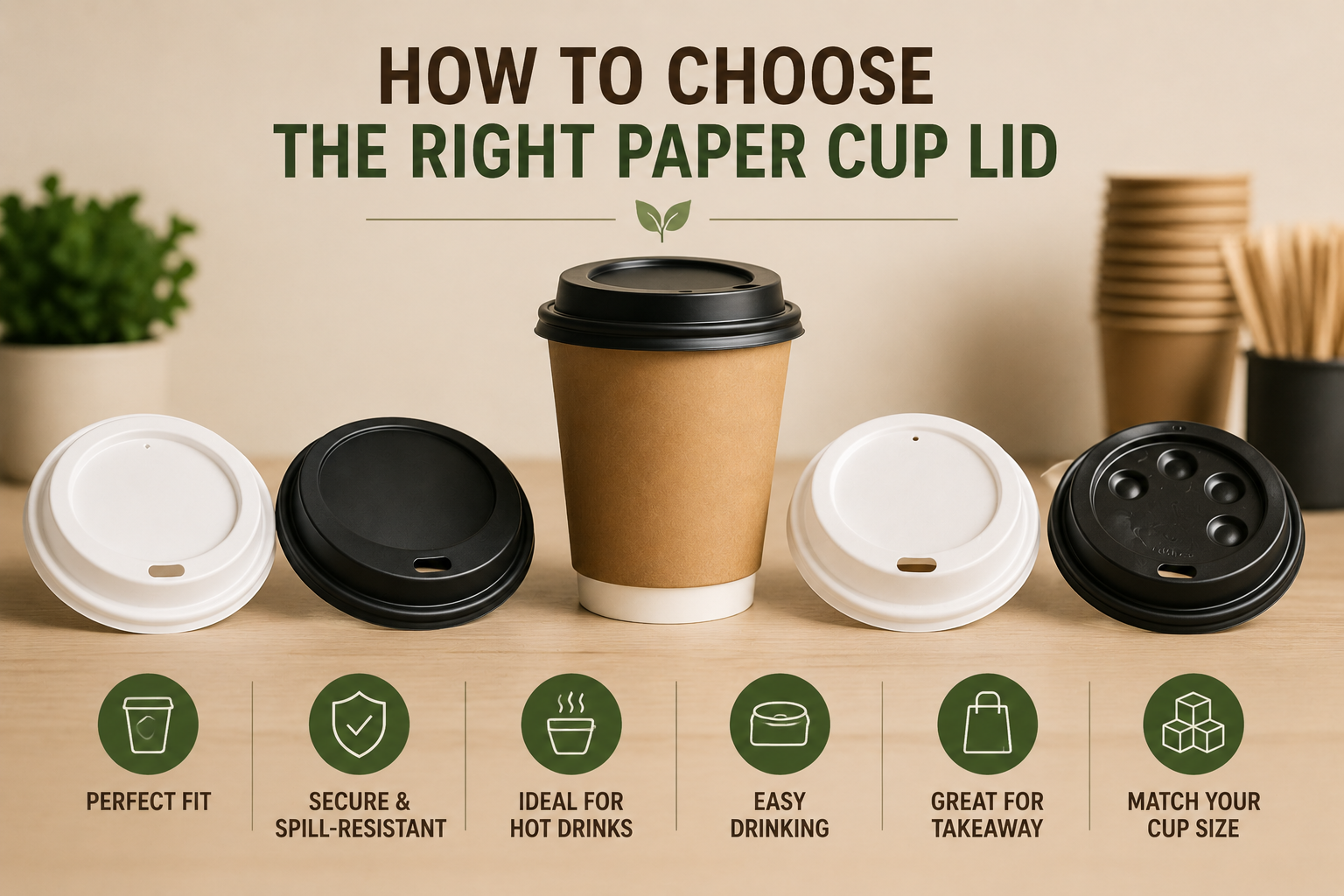
Not all takeaway coffee cup lids are created equal. The physical design of the lid, particularly the drinking opening, must correspond to the type of beverage you are serving and how the customer intends to consume it.
Sip Lids for Hot Drinks
Sip lids are the standard choice for hot beverages like coffee, tea, and hot chocolate. They feature a raised spout that allows the customer to drink comfortably without pressing their nose against the flat surface of the lid.
Crucially, well-designed sip lids feature a tiny pinhole vent opposite the drinking spout. When serving paper coffee cups with lids, this ventilation hole is vital. It allows the steam from a hot beverage to escape safely. Without this vent, the steam would create a pressure build-up inside the cup, eventually forcing the lid to pop off unexpectedly. Furthermore, the vent allows air to enter the cup as the liquid is consumed, ensuring a smooth, continuous flow rather than a spluttering pour that could burn the user.
Dome Lids for Cold and Specialty Drinks
For businesses serving iced coffees, frappes, milkshakes, or specialty hot chocolates topped with generous amounts of whipped cream and marshmallows, standard flat lids are entirely unsuitable. Dome lids provide the necessary overhead clearance to protect the presentation of these premium beverages. They usually feature a wider central opening to accommodate a thick paper straw or a long spoon.
Flat Lids with Straw Slots
If your restaurant or catering business serves large volumes of chilled sodas, water, or standard iced teas, a simple flat lid with a central cross-slotted opening is usually the most cost-effective and practical solution. The cross-slot grips the straw securely and minimises splashing if the cup is knocked over.
Hot Drink Takeaway Use: Transporting Drinks and Avoiding Spills
The demands placed on coffee cup lids change significantly when a customer leaves your premises. A lid that seems secure when a barista hands it across a counter must also remain secure when a customer jogs to catch a train, drives over a speed bump, or navigates a crowded pavement.
Achieving a Secure Fit
A secure fit is characterised by a distinct “snap” or click when the lid is pressed onto the cup. This audible and tactile feedback assures the barista that the lid is locked in place. The lid should sit flush and evenly all the way around the rim. If a lid requires excessive force to apply, or if applying pressure to one side causes the opposite side to lift, the compatibility is incorrect, and the risk of a spill increases dramatically.
Protecting Your Customers
Avoiding spills is not just about saving the beverage; it is about customer safety and brand reputation. Hot milk and boiling water can cause severe discomfort and ruin clothing. Ensuring you have paired your hot cups with high-quality, closely fitted sip lids is an essential part of responsible foodservice operation.
Simplifying Ordering and Storage Considerations
Managing takeaway packaging inventory can be a headache for cafe managers and event organisers. Boxes of disposable products take up valuable space in small stockrooms. However, by understanding paper cup lid sizes, businesses can significantly simplify their ordering and storage processes.
The One-Lid System
Because the commercial packaging industry often standardises the rims of larger cups, you can design your menu to minimise the number of lid types you need to keep in stock.
For example, if you offer a 12oz regular coffee and a 16oz large coffee, you only need to purchase one box of 90mm lids to cover both sizes. This reduces the amount of storage space required and eliminates the risk of a barista accidentally grabbing the wrong lid during a busy morning rush.
If you introduce an 8oz size for flat whites, you will need to add a box of 80mm lids. Most cafes operate successfully with just these two standard lid sizes, clearly separated behind the counter to ensure smooth, rapid service. To explore our full range of cup sizes and their corresponding lids, view our [Paper Cups category], where you can navigate specifically to [12oz Paper Cups] or [16oz Paper Cups].
Key Questions to Ask Before Ordering Lids
Before committing to a wholesale order, review this checklist to ensure you are selecting the optimal lid configuration for your business requirements.
| Consideration Area | Questions Businesses Should Ask Before Ordering |
|---|---|
| Compatibility | Are these lids specifically designed to fit the exact brand and model of cups I use? |
| Size Matching | Do I know the exact rim diameter (e.g., 80mm or 90mm) of the cups I currently have in stock? |
| Menu Suitability | Do my drinks require standard sip lids, or do I serve cream-topped drinks that require dome lids? |
| Workflow | Can I streamline my inventory by choosing cup sizes that share the same 90mm lid diameter? |
| Safety | Do the sip lids feature an adequate ventilation hole to release steam from hot drinks safely? |
| Customer Transport | Are my customers likely to carry these drinks on public transport or in cars, necessitating an exceptionally tight fit? |
Conclusion
Choosing the right paper cup lids might seem like a minor detail, but it plays a starring role in the daily operations of your takeaway business. From ensuring a secure, spill-resistant fit to managing your stockroom inventory efficiently by matching 90mm rims, taking the time to understand your lid requirements pays dividends in customer satisfaction and staff efficiency.
Never assume a universal fit. Always check the specifications and pair your cups with lids designed to accommodate their exact rim diameter and rolled edge profile.
At Touch A Sky, we understand that reliable packaging is the foundation of a successful food and beverage service. We supply a comprehensive range of premium paper cups and compatible, secure lids designed specifically for the UK market. If you are ready to upgrade your takeaway offering or streamline your packaging inventory, [Contact / Get a Quote] today to discuss how our ranges can support your business.
Frequently Asked Questions (FAQ)
Why doesn’t my paper cup lid fit securely on my cup? If a lid does not fit securely, it is likely because the lid’s internal diameter does not precisely match the cup’s rim diameter, or the thickness of the cup’s rolled edge is incompatible with the lid’s groove. Always ensure you purchase lids specifically designed for the cup range you are using.
Do 12oz and 16oz paper cups use the same lids? In most commercial ranges, yes. Standard 10oz, 12oz, and 16oz paper cups typically share the same 90mm rim diameter. This allows businesses to use a single type of 90mm lid across multiple drink sizes, simplifying ordering and storage.
What is the standard lid size for an 8oz paper cup? Most 8oz paper cups, which are commonly used for flat whites and small coffees, feature a narrower rim diameter of 80mm. Therefore, they require specific 80mm lids and will not fit the 90mm lids used for larger cup sizes.
What is the tiny hole on top of a takeaway coffee lid for? The small pinhole on a hot drink sip lid acts as a ventilation vent. It allows steam to escape safely, preventing pressure build-up that could force the lid off the cup. It also helps air flow into the cup as you drink, ensuring a smooth pour.
Can I use flat lids with straw slots for hot drinks? It is not recommended. Flat lids with cross-slots are designed specifically for cold drinks where a straw is used. For hot drinks, a sip lid with a raised spout and a ventilation hole is required to protect the customer from steam and hot liquid splashes.