Operating a successful cafe, restaurant, or catering business in the UK involves making countless operational decisions. One of the most fundamental yet frequently overlooked choices is selecting the correct packaging. Specifically, navigating the various paper cup sizes available on the market can feel overwhelming for new operators and established businesses looking to refine their service.
The cups you serve your drinks in dictate more than just the physical volume of liquid your customers receive. They influence the flavour profile of your carefully crafted beverages, your profit margins, the speed of your barista’s workflow, and your available stockroom space. Choosing between an 8oz and a 10oz cup is not simply about a couple of extra fluid ounces; it is about deciding what kind of coffee experience your business wants to deliver.
In this comprehensive Touch A Sky guide, we will break down the practical differences between the most common disposable cup sizes. Whether you are serving high-end specialty coffee, robust builder’s tea, or indulgent iced frappes, understanding the nuances of 8oz and 12oz,cups will ensure you order exactly what your business requires.
Why Coffee Cup Sizes UK Matter for Your Business
Before diving into the specific measurements, it is vital to understand why getting your cup sizing right is so crucial for UK foodservice businesses.
First, consider the taste. In the world of espresso-based drinks, ratios are everything. A double shot of espresso contains a set amount of liquid and flavour. If you pour that double shot into an 8oz cup and fill the rest with steamed milk, you create a strong, coffee-forward drink. If you pour that exact same double shot into a 16oz cup and fill the rest with milk, the coffee flavour will be completely masked, resulting in a weak, milky beverage.
Second, consider your inventory and storage. Takeaway packaging takes up a significant amount of physical space. A small independent coffee shop may not have the stockroom capacity to hold boxes of four different cup sizes. Many operators choose to streamline their menu, offering only two sizes (for example, 8oz and 12oz) to simplify ordering, save space, and speed up service.
Finally, consumer psychology plays a role. UK consumers have come to expect certain visual cues from their takeaway drinks. When they order a “large”, they expect a substantial vessel. When they order a strong flat white, they expect a compact cup. Aligning your menu with standard coffee cup sizes UK consumers recognise helps manage expectations and guarantees customer satisfaction.
Exploring the Standard Disposable Cup Sizes
Let us explore the four core sizes that dominate the UK takeaway beverage market, looking at their specific applications and the types of businesses they suit best.
8oz Paper Cups: The Specialty Coffee Standard
Holding approximately 227ml of liquid, the 8oz size is the undisputed champion of the modern specialty coffee movement. As the UK’s palate has become more refined, consumers have actively sought out stronger, more balanced coffee flavours, stepping away from the oversized, milk-heavy drinks of the past.
The 8oz cup is the perfect vessel for drinks where the espresso needs to shine. It is the industry-standard size for a takeaway flat white, a long black, or a small Americano. Because the cup volume is restricted, baristas do not need to over-dilute the espresso with excessive amounts of milk or water.
Beyond specialty coffee, [8oz Paper Cups] are incredibly versatile. Catering companies frequently use them for serving hot drinks at outdoor events where a smaller, quicker beverage is preferred to keep queues moving. They are also the ideal size for children’s hot chocolates or warm milk (babyccinos), ensuring the portion is manageable for younger customers. If your business prides itself on the quality and tasting notes of your coffee beans, the 8oz cup is an absolute necessity for your inventory.
12oz Paper Cups: The High Street Favourite
If you order a “regular” or “medium” hot drink in almost any major UK high street coffee chain, you will be handed a 12oz cup. Holding approximately 340ml, this size is the commercial workhorse of the takeaway industry.
[12oz Paper Cups] are designed for volume and comfort. They are the ideal vessel for standard lattes, cappuccinos, mochas, and hot chocolates. The larger capacity allows for the addition of flavoured syrups, whipped cream, or marshmallows without overflowing the rim.
This size is also the standard for takeaway teas. A 12oz cup provides enough water to properly steep a standard tea bag, resulting in a robust brew that will survive the addition of cold milk. Additionally, restaurants and cafes offering takeaway soups or hot broths frequently utilise 12oz cups as a secure, insulated serving container. If you are opening a traditional cafe or takeaway business, the 12oz cup will almost certainly be your highest-selling size.
Paper Cup Sizes Comparison Table
To help you visualise how these sizes compare and where they fit into a standard UK business model, we have compiled this quick-reference table. Please note that beverage applications are common industry practices, not strict universal rules.
| Cup Size | Approx. Capacity (ml) | Common Beverage Applications | Suitable Business Types | When This Size is Preferable |
| 8oz | 227ml | Flat whites, small Americanos, cortados, kids’ drinks | Specialty coffee shops, event caterers, bakeries | When preserving a strong espresso-to-milk ratio is critical. |
| 12oz | 340ml | Regular lattes, cappuccinos, hot chocolates, standard tea | High street cafes, restaurants, takeaway counters | The standard UK “regular”. Essential for milk-heavy drinks and teas. |
Key Factors to Consider When Choosing Your Sizes
Selecting your disposable cup sizes involves more than just looking at the liquid capacity. Before you place a wholesale order, consider how these physical products will integrate into your daily operations.
1. Beverage Type and Menu Structure
Your menu should dictate your packaging, not the other way around. If your business is an artisan bakery focusing on quick espresso drinks and flat whites, you may only need 8oz cups. Conversely, if you run a dessert parlour that specialises in loaded hot chocolates with cream and toppings, you will lean heavily on 12oz and 16oz sizes to accommodate the extra ingredients. Look at your top-selling items and build your cup inventory around them.
2. Portion Sizes and Profit Margins
It is a simple equation: larger cups require more ingredients. When setting your menu prices, you must carefully calculate the cost of goods sold (COGS) for each cup size. Ensure that the price increment between a regular and a large drink adequately covers the cost of the larger cup, the extra milk, and the extra coffee.
3. Customer Expectations and Location
Consider your demographic. A cafe located inside a busy commuter train station will sell a high volume of large coffees to people wanting a drink to last their journey. A cafe situated in a quiet residential neighbourhood might sell more 8oz and 12oz drinks to locals popping in for a quick morning brew.
4. Cup Design and Insulation Type
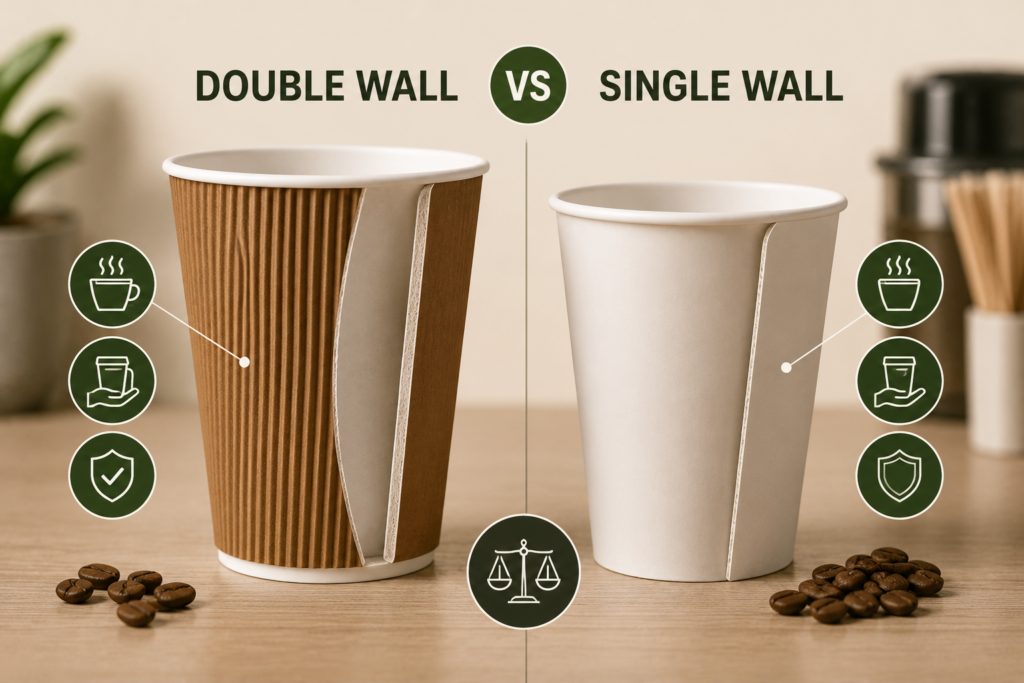
The size of the cup also interacts with the type of wall construction you choose. Because 8oz cups are often used for milk-based drinks (which are steamed to a drinkable temperature of around 60–65°C), single or double wall options are usually sufficient. However, 12oz cups are frequently used for teas made with boiling water. In this instance, you must consider investing in double wall or ripple cups to protect your customers’ hands from the intense heat, as a large single wall cup filled with boiling water is incredibly difficult to hold safely.
5. Lid Compatibility and Inventory Management
One of the best-kept secrets in takeaway operations is lid standardisation. In the commercial packaging industry 12oz, cups frequently share the same rim diameter (usually 90mm). This means one lid fits all three sizes.
Conversely, 8oz cups usually have a smaller 80mm rim diameter, requiring a specific lid. When choosing your sizes, mapping out your lid requirements can save you money and storage space. Stocking an 8oz and a 12oz cup means you need two types of lids.
Conclusion
Understanding the difference between 8oz vs 12oz paper cups is a foundational step in running a smooth, profitable takeaway beverage operation. By aligning your cup sizes with your specific menu, respecting the required coffee-to-milk ratios, and considering your stockroom space, you can offer a professional, consistent experience to every customer who walks through your doors.
At Touch A Sky, we provide commercial-grade packaging solutions designed to support the realities of the UK hospitality sector. Whether you need the precision of an 8oz cup for your specialty roasts or the volume of a 12oz cup for your summer iced menu, our ranges are built to perform reliably under pressure.
Ready to streamline your takeaway packaging? Explore our full range of sizes or reach out to our team to [Contact / Get a Quote] for wholesale pricing tailored to your business needs today.
Frequently Asked Questions (FAQ)
What is the most popular coffee cup size in the UK?
The 12oz paper cup is generally considered the most popular and versatile size in the UK market. It acts as the standard “regular” or “medium” across most high street cafes, providing enough volume for standard lattes, cappuccinos, and hot teas.
Can I use the same lid for different paper cup sizes?
Often, yes. In commercial ranges, 10oz, 12oz, and 16oz paper cups typically share a 90mm rim diameter, meaning one standard lid will fit all three. However, 8oz cups usually feature a smaller 80mm rim and require their own specifically sized lid.
Which paper cup size should I use for an iced coffee?
A 16oz paper cup is highly recommended for iced coffees. Because ice cubes displace a significant amount of liquid, using a larger cup ensures the customer still receives a generous and satisfying portion of the actual coffee and milk.
Is an 8oz cup too small for a standard coffee?
Not at all. An 8oz cup is the industry standard for specialty drinks like the flat white. It is designed to perfectly hold a double shot of espresso mixed with just enough micro-foamed milk to create a strong, well-balanced flavour profile without diluting the coffee.
Should I stock all four disposable cup sizes in my cafe?
Most independent cafes do not stock all four sizes due to space constraints and inventory costs. A very common and efficient strategy is to offer a two-size menu, such as 8oz (Small) and 12oz (Regular), or a three-size menu adding 16oz (Large) for iced drinks.